


Whiz - The Wonder Car of Tomorrow (Part One)

Updated: Apr 4


It was Sunday morning, two days after the funeral.
Finn Clarke pedalled hard through the quiet streets of Clanbury, the wind tugging at his hoodie, the sound of the thick BMX tyres rumbling roughly over tarmac. His legs burned a little- his Dad’s old Raleigh Vektar bike that his grandfather had fixed up wasn’t built for steep streets like this.
Finn was on his way to his grandfather’s home, his first visit since that fateful Monday nearly two weeks earlier. He felt like he needed to be there.
Alone.
To feel something. A sense of connection, perhaps? He felt empty. Numb. He was missing his grandfather terribly.
The conversations of the wake played heavily on his mind as he rode. It was full of older adult people Finn didn’t recognise, talking about things he knew nothing about. People were generally kind towards him, making small talk, letting him into their conversations, sharing their insights. One man asked Finn about his grandad’s fantastic car, and was surprised to learn it was still running - a gleaming red MG open top that his grandfather kept in the garage adjoining his home.
Others spoke about his grandfather’s career. He had learned much that he didn’t know before. He always knew Arthur Clarke had something to do with car manufacturing, but he didn’t know what he did. Suddenly he was full of questions. He never knew he worked abroad. What was he doing in Germany? What was he working on in Japan? Finn doubted he would ever see those people again to ask more.
Besides, there were much more important questions starting to bother him too, like why was his grandad so confused on the day he died? His grandad had a wonderfully sharp mind. He never got confused.
Finn reached the turning for Russett Street, his grandfather’s street, and turned right into it. He had to break and swerve as he narrowly avoided a pedestrian standing on the corner, too busy talking into his phone then watching where he was walking. Then again, he was riding along the pavement - perhaps it was he who should have been more careful? The street was a leafy, tree lined avenue, with a gentle gradient as the road sloped uphill. His grandfather’s house was about midway up, a tidy semi-detached, perched on the end of a longer run of houses.
As he drew nearer, Finn was startled by a car suddenly revving up, screeching, and making off far too quickly down the middle of the street. It seemed to start from somewhere in the vicinity of his grandfather’s house. The sound of the engine accelerating hard shattered the calm of the peaceful street. A sleek, unfamiliar saloon shot past him — low, dark, fast. He caught a blur of chrome, a silhouette behind the wheel, the glint of sunglasses — and then it was gone, tyres screeching slightly as it disappeared around the bend.
He braked instinctively, rolled off the pavement and down the little footpath that ran through the garden to the front door of his grandad’s house. To the right of the house, the detached side, stood the garage where his grandad kept his classic car. Finn was surprised to see the garage doors were wide open, the gleaming red MG peeped out from the inside. That’s strange, he thought. His Grandad never left the garage doors open because his MG was so precious to him, and he was sure his Dad would have secured the house during his last visit?
Finn dismounted his bike and propped it against the wall beside the front door, and walked over to the garage. There was nothing untoward to see. Everything was just as his grandfather would have left it, except the thick tarpaulin cover that usually protected the classic car had been pulled back, revealing the car spectacular paintwork and gleaning chrome. Finn’s grandfather NEVER left the car like that.
Finn replaced the cover properly, pulled the garage doors closed, and went to the front door of the house. He took out his spare key, and gingerly turned it in the latch. He opened the door gently and quietly. It was instinctive. He felt that something wasn’t right.
He need not have worried. There was no sign of anything untoward. Finn paused for a moment, took a breathe, and drank in the silence. Everything was, unsurprisingly, exactly as his grandfather had left it. Everything neat and tidy. No washing up. No signs of life. Tea towels had been folded neatly over the oven handle, and a dishcloth had been folded neatly over the kitchen tap. The tap emitted a gentle drip, but other than that, nothing. A thick silence that pressed in behind Finn’s ears. The house was still. Just a sad, quiet old man’s home. Dead.
He made his way out of the kitchen and into the living room. It was a room he adored. Once. Suddenly it felt drab and soulless. The one person who belonged here, the person he craved to see more than anyone, was gone. The air smelled like old varnish and lavender. Familiar. Heavy.
He made his way to the table in the window with the chessboard resting on it. He loved playing chess with his grandfather. They had played every afternoon after school. The chessboard was a competition standard Staunton set and very beautiful. It was a large, deep walnut and maple chess board mounted on a thick wooden base. Highly polished, with a set of 32 weighted, handcrafted and felted chessmen, each turned from solid wood and painstakingly carved.
It was now his, left to him in his Grandfather’s Will. It was a curious thing to be left in a Will. Normally Will’s talk about houses, and finances, cars and big ticket possessions such as fine artworks which were worth a lot of money. This old chess set, as lovely as it was, wasn’t worth THAT much, yet curiously his grandad had left very specific and very special instructions, “To my grandson Finn”, his father had read out “I leave our favourite chessboard, and all the wisdom it contains”. It was an odd wording, but Finn supposed it made sense to his grandfather.
The chessmen were poised, seemingly frozen in time since their last great battle together. Finn reminisced. It had begun as it always had, with Finn playing white while his grandfather followed the same sequence of "book moves" like some kind of ritual:
Pawn to e5
Knight to c6
Bishop to c5
There was a rhythm to it which Finn had memorised over their years of play together.
Finn had been curious and had asked his grandfather why it always started the same way. He had just laughed “Oh hah hah! This chess board contains great wisdom which you’ll unlock yourself one day. The key to anything is getting started. Keep studying,” he said, a wink in his eye. “You’ll find it.”
Finn collapsed into his regular chair at the memory of it and sobbed. Once he started crying he couldn’t stop. The emotional gates which held back the tears for two weeks had been smashed down and he sobbed and sobbed with pain and sadness.
“I hate you!” He cried out “I hate you for leaving me!”. He slammed his arm down onto the board, swiping the lifeless chess pieces onto the floor in anger, frustration and upset. As he did so, something odd happened - a tile of the chess board popped up, like the lid of a jack-in-the-box toy.
Finn examined the square closely. It was hinged, from below, the mechanism hidden beneath the tile. It had sprung free from a clasp keeping it shut. The feelings of upset gave way to a shiver down his spine and a rising feeling of excitement as, intrigued, he lifted the tile fully. Beneath, a hollow void. A secret compartment hidden in the base. Inside, a curious object. Finn didn’t recognise what it was but it certainly wasn’t a part of the chess set. He lifted it out. It was metallic, teardrop shaped, with a computer chip and strange markings etched into it. What was it? Why was it?
It had been hidden there very deliberately. What was it his grandfather had said? The chessboard and all of the wisdom it contains? What it was, it was meant for him.
Finn got up from the chair, suddenly very conscious that he was doing something very secretive, and worried he was about to get caught. Adrenalin was now pumping through his body.
He began searching the room, looking for some kind of clue. His eyes darted along the mantle piece and onto the bookshelves, briefly alighting on the photograph of his grandfather at a car factory, being presented a certificate. He now recognised the man shaking his hand as a much younger version of a man at the funeral. He didn’t dwell upon it for long. He was too excited.
His search of the living room proved fruitless so he hurriedly searched through the dining room and the kitchen, lifting tins and looking behind cabinet doors. There was nothing. He went into the hallway, opened the front door, and peered through the open doors of the garage. There was nothing in there either.
He went back into the house, raced upstairs and began searching the bedrooms. First his grandfather’s bedroom at the front of the house, then the two smaller bedrooms, then the bathroom. Nothing.
Finn sighed, went into the nearest bedroom and sat on the edge of the bed to stop and think. There MUST be something. His eyes wandered around the room slowly, and outside through the plate glass window overlooking the rear garden.
A thought struck him.
The garden of his grandfather’s house was much like any other old person’s garden. Immaculately kept. Beautiful roses and flowers in flower beds and along the fences of the neighbouring houses. But at the foot of the garden, right at the rear, there was a second garage. Finn didn’t know much about it, only that was a concrete bunker, hand built by his grandfather many years ago after Finn’s grandmother had passed, long abandoned. That end of the garden was unwelcoming. Overgrown and unkempt, full of nettles, thistles and weeds. Finn had never been inside it and had never had any desire to go down there. Until now.
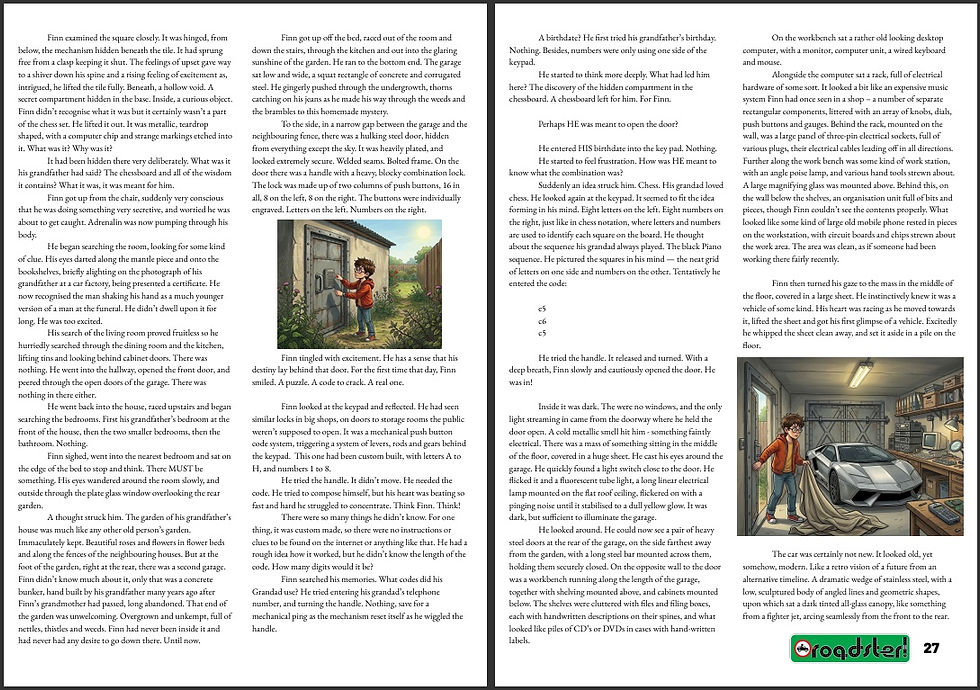
Finn got up off the bed, raced out of the room and down the stairs, through the kitchen and out into the glaring sunshine of the garden. He ran to the bottom end. The garage sat low and wide, a squat rectangle of concrete and corrugated steel. He gingerly pushed through the undergrowth, thorns catching on his jeans as he made his way through the weeds and the brambles to this homemade mystery. To the side, in a narrow gap between the garage and the neighbouring fence, there was a hulking steel door, hidden from everything except the sky. It was heavily plated, and looked extremely secure. Welded seams. Bolted frame. On the door there was a handle with a heavy, blocky combination lock. The lock was made up of two columns of push buttons, 16 in all, 8 on the left, 8 on the right. The buttons were individually engraved. Letters on the left. Numbers on the right.
Finn tingled with excitement. He has a sense that his destiny lay behind that door. For the first time that day, Finn smiled. A puzzle. A code to crack. A real one.
Finn looked at the keypad and reflected. He had seen similar locks in big shops, on doors to storage rooms the public weren’t supposed to open. It was a mechanical push button code system, triggering a system of levers, rods and gears within the mechanism. When the correct code was entered the system aligns in a specific way, allowing the door handle to be turned. This one had been custom built, with letters A to H, and numbers 1 to 8.
He tried the handle. It didn’t move. He needed the code. He tried to compose himself, but his heart was beating so fast and hard he struggled to concentrate. Think Finn. Think!
There were so many things he didn’t know. For one thing, it was custom made, so there were no instructions or clues to be found on the internet or anything like that. He had a rough idea how it worked, but he didn’t know the length of the code. How many digits would it be?
Finn searched his memories. What codes did his Grandad use?
He tried entering his grandad’s telephone number, and turning the handle. Nothing, save for a mechanical ping as the mechanism reset itself as he wiggled the handle.
A birthdate? He first tried his grandfather’s birthday. Nothing. Besides, numbers were only using one side of the keypad.
He started to think more deeply. What had led him here? The discovery of the hidden compartment in the chessboard. A chessboard left for him. For Finn.
Perhaps HE was meant to open the door?
He entered HIS birthdate into the key pad. Nothing.
He started to feel frustration. How was HE meant to know what the combination was?
Suddenly an idea struck him. Chess. His grandad loved chess. He looked again at the keypad. It seemed to fit the idea forming in his mind. Eight letters on the left. Eight numbers on the right, just like in chess notation, where letters and numbers are used to identify each square on the board. He thought about the sequence his grandad always played. The black Piano sequence. He pictured the squares in his mind — the neat grid of letters on one side and numbers on the other. Tentatively he entered the code:
e5
c6
c5
He tried the handle. It released and turned. With a deep breath, Finn slowly and cautiously opened the door. He was in!
A cold metallic smell hit him - something faintly electrical.
Inside it was dark. The were no windows, and the only light streaming in came from the doorway where he held the door open.
There was a mass of something sitting in the middle of the floor, covered in a huge sheet. He cast his eyes around the garage. He quickly found a light switch close to the door. He flicked it and a fluorescent tube light, a long linear electrical lamp mounted on the flat roof ceiling, flickered on with a pinging noise until it stabilised to a dull yellow glow. It was dark, but sufficient to illuminate the garage.
He looked around. He could now see a pair of heavy steel doors at the rear of the garage, on the side farthest away from the garden, with a long steel bar mounted across them, holding them securely closed. On the opposite wall to the door was a work bench running along the length of the garage, together with shelving mounted above, and cabinets mounted below. The shelves were cluttered with files and filing boxes, each with handwritten descriptions on their spines, and what looked like piles of CD’s or DVDs in cases with hand-written labels. On the work bench sat a rather old looking desk top computer, with a monitor, computer unit, a wired keyboard and mouse.
Alongside the computer sat a rack, full of electrical hardware of some sort. It looked a bit like an expensive music system Finn had once seen in a shop – a number of separate rectangular components, littered with an array of knobs, dials, push buttons and gauges. Behind the rack, mounted on the wall, was a large panel of three-pin electrical sockets, full of various plugs, their electrical cables leading off in all directions. Further along the work bench was some kind of work station, with an angle poise lamp, and various hand tools strewn about. A large magnifying glass was mounted above. Behind this, on the wall below the shelves, an organisation unit full of bits and pieces, though Finn couldn’t see the contents properly. What looked like some kind of large old mobile phone rested in pieces on the work station, with circuit boards and chips strewn about the work area. The area was clean, as if someone had been working there fairly recently.
Finn then turned his gaze to the mass in the middle of the floor, covered in a large sheet. He instinctively knew it was a vehicle of some kind. His heart was racing as he moved towards it, lifted the sheet and got his first glimpse of a vehicle. Excitedly he whipped the sheet clean away, and set it aside in a pile on the floor.
The car was certainly not new. It looked old, yet somehow, modern. Like a retro vision of a future from an alternative timeline. A dramatic wedge of stainless steel, with a low, sculptured body of angled lines and geometric shapes, upon which sat a dark tinted all-glass canopy, like something from a fighter jet, arcing seamlessly from the front to the rear.
The car was narrower at its nose, with hidden headlights, and a stylised emblem on the tip of the nose, like a letter “W” fashioned into two lightning bolts which Finn immediately recognised as the symbol on the object from the chess board.
The car widened out around the middle of the canopy, with air intake ducts flanking either side, before the whole thing tapered back again at the rear to form a precise, purposeful tail.
It looked aerodynamic, aggressive, and fast. It was unlike anything Finn had ever seen. It was theatre, technology, and sculpture, all at once.
There were no doors that Finn could see. The surfaces were smooth, with sheet steel meeting at angles. He examined the object he was still gripping tightly in his left hand. The brushed steel was a match.
He pressed the button on the fob. Nothing.
Finn then searched around the car more closely, hunting for some kind of access point. There must be a way to get inside. He searched for a panel of some kind, perhaps a flap containing some kind of access mechanism? He found what he was looking for. A panel on the nose of the car, just below the stylised “W”. He pushed it gently and it popped open, revealing some kind of socket for a power connection.
Finn’s eyes darted around the garage and found a coiled power cable beneath the work bench. He tried plugging it into the car. It was a perfect fit.
He then traced the other end of the cable, and found it retreating out of the garage, alongside a huge lever. He yanked it downward, and there was a low electrical humming noise as electricity surged along the cables and into the car.
Finn ran his thumb across the object in his hand, brushing the “W” shape. Suddenly there was a hiss and a mechanical whine from the car as a entire glass canopy rose up from the bodywork, and slid backwards to reveal the cockpit inside.
Finn was presented with the incredible sight of a wrap around digital display, a steering yoke, low, reclined seating, like fighter pilot seats and a luxurious cabin of thick carpet, stitched leather and brushed metal work. This was not a regular car. This was something else.
Excitedly Finn clambered into the drivers seat. He had come this far, perhaps it would start up? He looked around for an ignition, or a start button. There was nothing. He reached his foot out and pressed on the pedals. Nothing again.
He pondered, looking about the wrap around dashboard for some kind of hint at what he should do. Suddenly, he saw it. Right there, in the middle of the dash, between the driver’s seat and passenger seat. A shape, an outline, a space for something missing. The space matched the object in his hand. It was a key!
Finn put the key into the space. It fit perfectly. As he did so, the dashboard sprang into life.
One by one, old systems began to stir.
A mechanical relay snapped into life. Tiny fans spun somewhere behind the dash. A glass monitor built between the two seats crackled, fizzed, then settled into a green blinking cursor.
Finn stared, mouth slightly open.
On the screen, a single word appeared, one flickering pixel at a time:
> INITIATING SYSTEMS…
Then a pause before a slow boot sequence scrolled down the screen and a hard drive hidden somewhere in the body of the car clicked and churned. Line after line of text: diagnostics, hardware pings, memory blocks reinitialised.
An array of dashboard screens flickered into life, running black and white schematics and computer code which scrolled automatically as programs ran. A map flashed up on one screen, followed by a pinging noise as a radar swept in a circle across the surface of the map. A fan started up from deep in the rear of the car behind the seats, there were swooshes and electronic beeps as different systems came online. The drivers dashboard lit up in an array of lights and warning systems, function and control buttons lit up, then, just as suddenly, stillness, as everything stopped. Everything except a hovering, whirring noise coming from behind him. The scrolling code on the glass monitor stopped scrolling and settled:
SYSTEM INITIATED. ACTIVATION COMMENCING.
>
A cursor blinked.
Suddenly there was a voice. “Hello Finn Clarke. I’ve been waiting for you.”


Comments